The Dictionary Quietly Took a Word Back. Nobody Announced It.
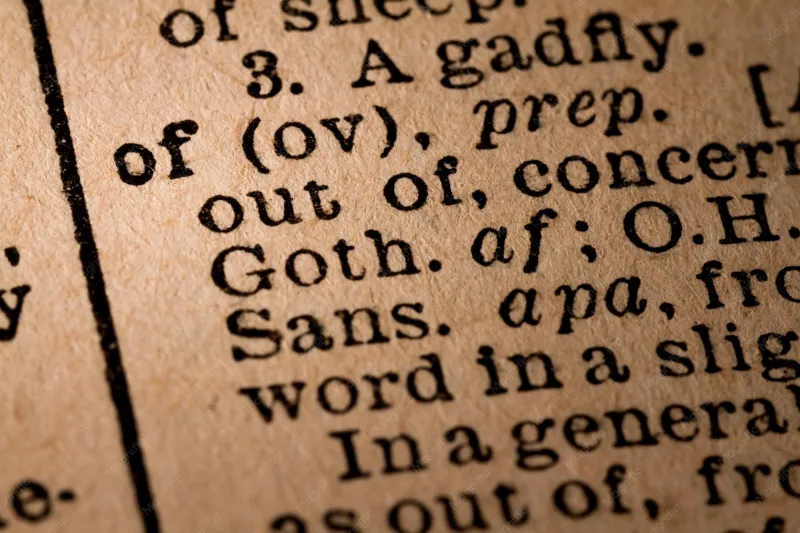
Photo: old dictionary open pages close up vintage, via img.freepik.com
Somewhere in the offices of a major dictionary publisher, there is a person whose job involves deciding whether a word exists.
Not whether the word is being used — it obviously is, or it wouldn't be under consideration. Not whether people know what it means — they clearly do. The question is whether the word has earned the right to appear in the official record. Whether it gets to be, in the peculiar cosmology of lexicography, real.
This process is less scientific than you'd hope and more political than you'd expect. And occasionally, it goes wrong in ways that take decades to correct — usually without anyone admitting that anything went wrong at all.
The Authority That Wasn't Supposed to Have Authority
American dictionaries have always occupied a strange cultural position. The founders of Merriam-Webster, the company that grew from Noah Webster's original 1806 work, never intended their product to function as a rulebook. Webster was trying to document American English as it was actually spoken — distinct from British English, evolving, alive.
But somewhere along the way, Americans decided that if a word was in the dictionary, it was real, and if it wasn't, it wasn't. Teachers enforced this. Style guides enforced it. The dictionary became, by popular consensus, an authority it had never claimed to be.
This created a feedback loop with real consequences. Words left out of major dictionaries didn't just get labeled informal — they got treated as illegitimate. Using them in formal writing invited correction. Seeing them in print felt like an error. The dictionary's silence became, functionally, a ban.
The Removal You Didn't Hear About
In 1939, Merriam-Webster removed the word dord from its dictionary after discovering it had been included by mistake. A slip of paper reading "D or d" — shorthand indicating that a capitalization entry applied to both upper and lowercase — had been misread as a single word and defined as a physics and chemistry term for "density." It had appeared in the dictionary for five years before an editor caught it.
The correction was made quietly. No press release. No apology. The word simply disappeared from the next edition, and most people who owned copies of the old edition never knew they had a ghost word sitting on their shelf.
Dord is the most famous example of what lexicographers call a "ghost word" — a word that exists in the dictionary but nowhere else, usually born from a copying error or a misread note. Dictionaries have contained dozens of them over the centuries. Most were caught and removed. A few weren't, and their phantom definitions propagated into other reference works before anyone noticed.
When Politics Pulled the Trigger
Not every removal is an accident. Some are decisions — and some of those decisions age badly.
In the mid-20th century, several major American dictionaries came under pressure to remove or heavily qualify words associated with racial slurs, sexual content, and political terminology that had become contested. Some publishers responded by simply cutting entries. Others added usage notes so lengthy and negative that the effect was similar — the word was technically present but practically discouraged.
The word ain't has a particularly tortured history. Recognized as regional American English for more than a century, it was removed from or heavily stigmatized in major dictionaries through much of the 20th century on the grounds that it was "uneducated." When Merriam-Webster's Third New International Dictionary included it without strong condemnation in 1961, the backlash was significant enough to make national news. The New York Times ran an editorial. Wilson Follett, a prominent usage critic, called the dictionary's approach "a scandal and a disaster."
The word ain't was, of course, not going anywhere. People were using it constantly, had been for generations, and would continue to regardless of what any editorial board decided. The dictionary eventually caught up. It always does.
The Quiet Reinstatements
Here's the part that doesn't get talked about much: when words come back, they rarely come back with fanfare.
Dictionary publishers announce new additions enthusiastically — every year, Merriam-Webster and Oxford both issue press releases highlighting the newest entries, which reliably generate news coverage. Selfie. Ghosting. Cryptocurrency. The additions are events.
The reinstatements aren't. When a word that was removed, suppressed, or quietly downgraded gets restored to full standing, it tends to happen in the body of a new edition without any acknowledgment that it was ever gone. Readers who notice have to do the comparison themselves — old edition versus new, entry by entry.
This isn't necessarily cynical. Lexicographers would argue, reasonably, that announcing a reinstatement would require explaining the removal, which would require defending a decision that probably shouldn't have been made in the first place. Silence is tidier.
What a Dictionary Actually Is
The strangest thing about this whole history is what it reveals about the nature of the enterprise.
A dictionary is supposed to be a record of language — descriptive, not prescriptive. It documents what words mean and how they're used, not what words should mean or should be used. That's the official position of every major lexicographic institution.
But in practice, the record has always been shaped by the people keeping it. By their assumptions about which varieties of English count. By the social pressures of their moment. By the occasional misread note that turns a filing shorthand into a fake physics term.
The English language has somewhere between 170,000 and one million words, depending on how you count. No dictionary contains all of them. Every edition is a selection — an argument, made in ink, about what deserves to be remembered.
Some words lose that argument for a while. Then they win it back. The dictionary updates, quietly, and moves on.
The word was always real. The dictionary just needed time to admit it.