For Ninety Seconds, a Radio Station Played the Same Moment Twice — and Nobody Could Explain It
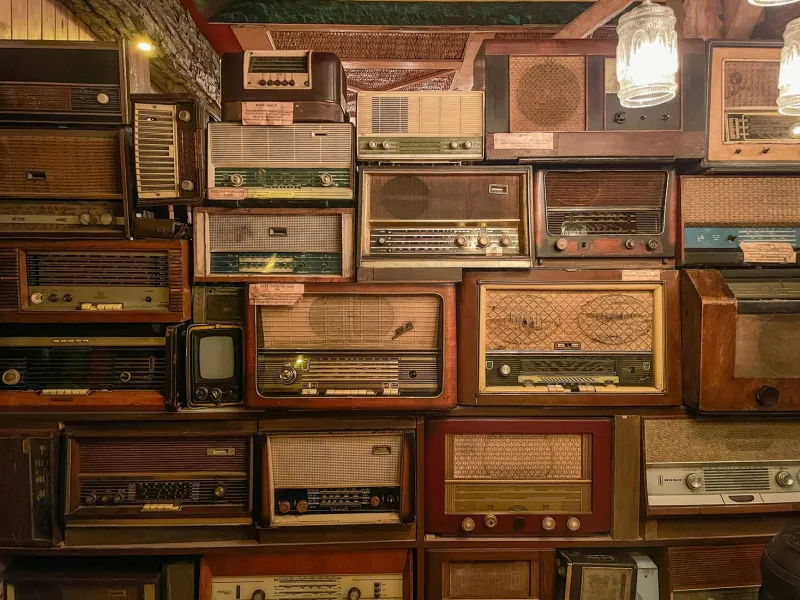
Live radio is, by definition, unrepeatable. The whole point — the thing that made it thrilling in its early decades and still gives it a particular electricity today — is that it's happening right now, in real time, with no safety net. There's no rewind. There's no second take. When something goes wrong on live radio, it goes wrong in front of everyone, and then it's gone.
Except for one afternoon in the mid-20th century, at a regional broadcasting station in the American Midwest, when something went wrong in a way that shouldn't have been possible at all. For approximately ninety seconds, the station broadcast the same stretch of live programming twice — in immediate succession, with no perceptible gap between them.
Listeners heard the announcer say the same sentence twice. They heard the same musical transition repeat. They heard the same advertisement play through a second time, word for word, beat for beat, before the broadcast continued normally as if nothing had happened.
The station's engineers spent weeks trying to figure out how.
What the Listeners Heard
The first calls came in within minutes of the broadcast returning to normal. Listeners were confused in the particular way people get confused when reality doesn't behave the way they expect it to — not alarmed, exactly, but unsettled. Several described the experience as feeling like a skip on a record, except that a skip compresses time, not expands it. What they'd heard was an expansion: the same ninety seconds, intact and complete, played out twice in a row.
A few callers assumed it was a technical demonstration of some kind — a new piece of equipment being tested. A few others wondered if they'd briefly dozed off and missed the transition back. One caller, according to a station log from the period, simply asked: "Did that just happen to everyone, or just me?"
It had happened to everyone. The station's switchboard confirmed it.
What the Engineers Found
The broadcast setup at mid-century regional stations was a layered system of live microphones, transcription discs (large-format recordings used for delayed playback of prerecorded segments), and a routing board that directed audio between sources and out to the transmitter. The combination of live and recorded elements in a single broadcast was common — an announcer might introduce a prerecorded musical segment, return for live commentary, then throw to a transcription of an advertisement.
The initial theory was simple: a transcription disc had been cued incorrectly and had briefly overridden the live feed, replaying the previous segment. This kind of error happened occasionally and was generally easy to diagnose. You found the disc, confirmed the content, matched it to the timestamp of the anomaly, and filed a report.
Except no disc matched the content. The ninety seconds that repeated included live announcer commentary that had not been recorded to any transcription disc in the station's inventory. It included an in-progress musical performance that was happening in the studio at that moment. There was no physical medium that could have contained those ninety seconds, because those ninety seconds had only just occurred.
The Competing Theories
What followed was the kind of investigation that happens when engineers are confronted with something that doesn't fit their mental model of how their equipment works.
The first serious technical explanation involved a signal reflection — a phenomenon where a transmitted radio signal bounces off a geographic or atmospheric feature and returns to the source, potentially being inadvertently re-broadcast. Signal reflections were a known issue in radio, particularly in areas with significant terrain variation. If the reflected signal had somehow been picked up by the station's own receiving equipment and routed back into the broadcast chain, it might — in theory — have caused a brief playback loop.
The problem with this theory was the timing. A reflected signal that traveled far enough to return ninety seconds later would have had to travel an extraordinary distance — roughly 16,000 miles, given the speed of radio waves. That's not a reflection. That's a signal that went most of the way around the planet.
A second theory involved a fault in the routing board itself — a relay that had stuck in a feedback configuration, briefly feeding the board's output back into its own input. This was more technically plausible, but it still didn't fully account for the fidelity of the repeated segment or the clean resumption of normal programming afterward.
A third theory, offered informally by one of the station's senior engineers and never officially endorsed, was that the event hadn't actually happened the way listeners described it. That mass suggestion, combined with a more mundane technical glitch, had created a false consensus about what people had heard. This theory was not popular with the listeners who had called in.
What Was Eventually Documented
The station filed a report with the FCC detailing the incident. The report is notable primarily for what it doesn't contain: a definitive explanation. The engineers documented the anomaly, described the competing theories, and noted that no physical cause had been conclusively identified. The routing board was inspected and found to have a minor relay irregularity that was repaired, though the engineers acknowledged this might have been coincidental.
The incident made its way into early broadcasting trade publications as an unresolved curiosity. Engineers at other stations wrote in with their own theories. None of them were conclusive either.
Why It Stayed Strange
Part of what makes this story durable is that it sits at the intersection of two things people find deeply unsettling: technology behaving in ways it shouldn't, and time doing something it's not supposed to do.
The ninety-second loop wasn't dangerous. Nobody was hurt. The broadcast recovered. In the grand catalog of radio disasters, it barely registers. But it left behind a documented record of something that, by all accounts of how radio equipment worked, shouldn't have been possible — and a collection of listener testimony that was consistent enough to rule out mass confusion.
The station stayed on the air for another thirty years. Engineers who worked there in subsequent decades apparently kept the FCC report in a filing cabinet, not as a source of pride exactly, but as a reminder that sometimes the equipment does something the manual doesn't cover.
Ninety seconds of the same moment, played twice, for reasons that were never fully resolved. In the history of American broadcasting, it remains one of the more genuinely strange entries in the logbook.