The Library Card That Wouldn't Die: How a Slip of Paper Outlived Five Generations
Most people lose their library cards behind a couch cushion or at the bottom of a junk drawer. They expire, get replaced, or just quietly stop working. What almost never happens is that a library card issued before the invention of the automobile remains fully valid — and usable — more than a century after the person who first held it is buried.
And yet.
A Box in the Basement
The story starts, as many genuinely strange stories do, with someone cleaning out a deceased relative's belongings. A woman in a small Ohio town — the kind of place where the library doubles as the local historical society and the librarian has worked there for thirty years — found a wooden recipe box tucked into a closet shelf. Inside, among clipped coupons and handwritten pie recipes, was a small rectangular card. Stiff, yellowed at the edges, printed in the typeface of another era entirely.
It was a library borrowing card. Issued by the town's public library. Dated 1886.
The name on it was her great-great-grandmother's.
She brought it to the library mostly as a curiosity — the kind of artifact you show the librarian because you figure they'd get a kick out of it. What she did not expect was for the librarian to look up the card number in the system and find it listed as active.
The Records That Time Forgot
To understand how this happened, you have to understand what library record-keeping looked like before computers, and — more importantly — what it looked like during the chaotic, underfunded transition to computers.
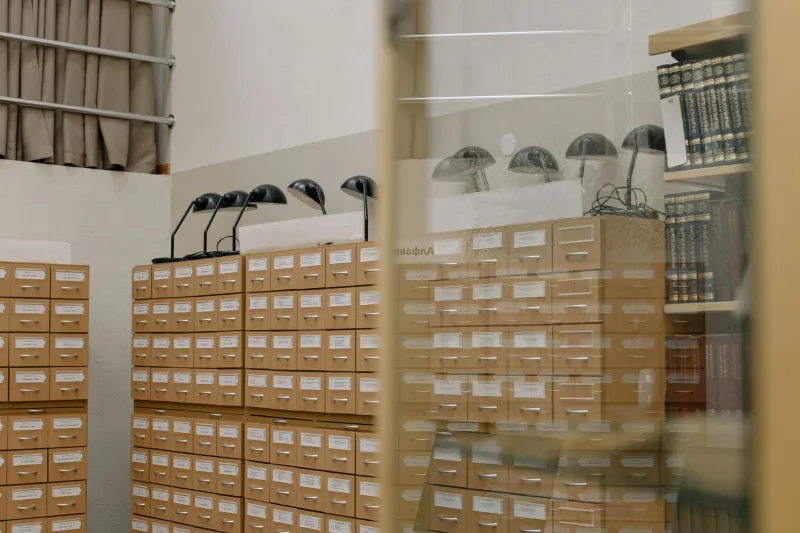
For most of the twentieth century, small-town libraries maintained borrower records on physical index cards stored in long wooden drawers. When a patron died or moved away, their card wasn't always formally deactivated. It just stopped being used. The drawer kept filling up. The cards kept sitting there.
When this particular Ohio library finally digitized its patron records in the early 2000s, a volunteer data-entry team worked through stacks of those old cards and entered them into the new system. The goal was to preserve historical records, not to audit them. Cards that had never been formally closed out were entered as-is. Including, apparently, one issued in 1886 to a woman who had passed away sometime in the 1940s.
The card number was live. The account showed no outstanding fines. In the system's logic, there was no reason to flag it.
When the Computer Said Yes
What makes this story genuinely remarkable — and slightly absurd — is what happened next. The woman who found the card, more out of curiosity than any real intention, handed it to the librarian and asked, half-jokingly, if it still worked.
The librarian scanned it.
The system accepted it.
They both stood there for a moment.
Then the librarian, to her credit, laughed.
She also immediately called the library director, who called the county records office, and who eventually looped in a local historian. What followed was a weeks-long investigation into how exactly the card had survived the digitization process not just intact, but functional. The answer, once they traced it, was straightforward enough: the data-entry volunteer had typed the card number into the system without checking whether it corresponded to a living patron. The system had no automatic cross-reference with death records. It simply logged what it was given.
What a 137-Year-Old Library Card Actually Reveals
It would be easy to treat this as a charming quirk — a feel-good story about a dusty piece of cardstock and a small-town library's endearing organizational chaos. And it is charming. But it's also a window into something worth paying attention to.
Institutional record-keeping is full of gaps like this one. Not dramatic gaps. Not the kind that make headlines or trigger audits. Just quiet, accumulating oversights — records that were never closed, accounts that were never retired, data that was migrated forward without anyone stopping to ask whether it should be.
Libraries aren't unique in this. Municipal water records, property deed archives, old voter rolls — all of them carry legacy data that was entered by human hands under time pressure and never fully reviewed. Most of the time it doesn't matter. Occasionally, it produces something like a 137-year-old library card that the computer insists is perfectly valid.
The card has since been retired from the system. The library framed a photocopy of it and hung it near the circulation desk. The original went back to the family, who put it somewhere considerably safer than a recipe box.
The great-great-grandmother, for her part, apparently had no outstanding fines at the time of her death. Her record was spotless.
Some people just return their books on time.