A Chimpanzee Walked Into Court. The Judge Had to Think About It.
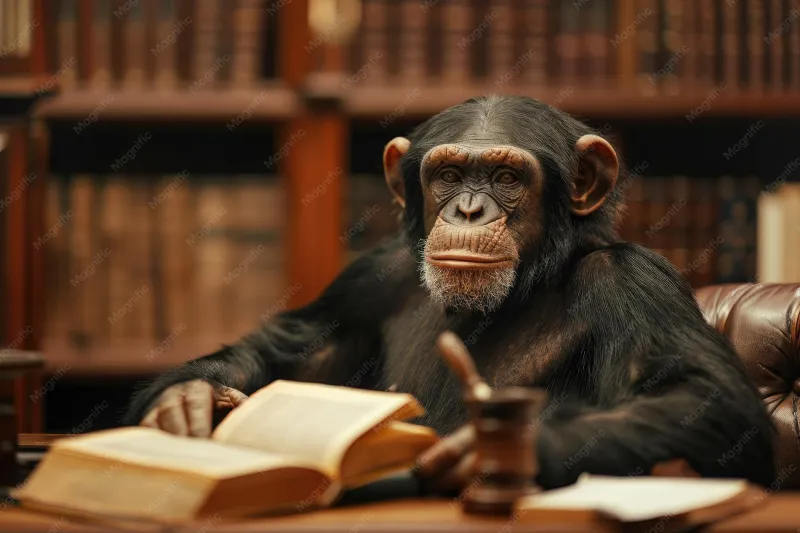
Photo: chimpanzee looking through courtroom window thoughtful, via img.freepik.com
In December 2015, a judge in Suffolk County, New York, signed a writ of habeas corpus. That's a legal document demanding that a detained person be brought before the court to determine whether their imprisonment is lawful. It's a cornerstone of American civil rights law, one of the oldest protections in the English-speaking legal tradition.
The detainee in question was a chimpanzee named Hercules.
This wasn't a stunt. It wasn't performance art. It was a legitimate legal filing that a sitting judge took seriously enough to act on — and it opened a debate that American courts are still, quietly and uncomfortably, trying to resolve.
The Setup Nobody Saw Coming
The Nonhuman Rights Project, a legal advocacy organization founded by attorney Steven Wise, had spent years building the argument that certain cognitively complex animals — chimpanzees, elephants, dolphins, whales — possess enough self-awareness and autonomy to deserve basic legal rights. Not the right to vote. Not the right to own property. Just the most fundamental right of all: the right not to be imprisoned without cause.
Habeas corpus, in other words.
Wise filed petitions on behalf of several chimpanzees held at research facilities and private properties in New York. The cases were dismissed. Then refiled. Then appealed. One judge in Manhattan agreed, in 2015, to hold a hearing — the first time in American history that a court formally considered whether a nonhuman animal deserved the protections of personhood.
The university holding Hercules argued, predictably, that a chimpanzee is property. The Nonhuman Rights Project argued that personhood and humanity are not the same thing — that corporations, after all, are legal persons, and they're not human either.
The judge ultimately ruled against Hercules. But she didn't dismiss the argument out of hand. She wrote that the issue was "understandably fraught" and suggested the question deserved attention from higher courts.
That's a remarkable sentence to find in a legal opinion about a chimpanzee.
The Story Starts Earlier — and Darker
To understand how America got here, you have to go back to January 4, 1903, at Luna Park in Coney Island, where a 28-year-old elephant named Topsy was publicly electrocuted in front of a crowd of roughly 1,500 people.
Topsy had killed three men — one of whom, by most accounts, had fed her a lit cigarette — and was deemed too dangerous to keep. The ASPCA refused to hang her, as had been originally proposed. So the park's management, working with Thomas Edison's company, rigged her with copper-sandal electrodes and ran 6,600 volts through her body. Edison's team filmed it. The footage still exists.
Topsy died in about ten seconds.
Edison, who was in the middle of his infamous PR campaign against alternating current, used the event to demonstrate the dangers of AC power. The elephant was, in the eyes of the law and everyone present, a piece of property being disposed of. Nobody was charged with anything. Nobody was expected to be.
The incident didn't spark legal reform. But it lodged itself in the cultural memory of how America treats the animals it finds inconvenient — and it became, over a century later, a reference point for advocates arguing that the legal framework around animals was overdue for reconsideration.
The Elephant in the Room (Literally)
In 2022, the Nonhuman Rights Project took their argument to the Bronx. Happy, an Asian elephant living alone at the Bronx Zoo, became the subject of a habeas corpus petition that reached New York's highest court — the Court of Appeals.
The court ruled 5-2 against Happy. But the two dissenting judges wrote opinions that read less like legal disagreements and more like philosophical arguments. One dissent ran over 50 pages. It argued that Happy demonstrated the cognitive and emotional complexity that should, by any reasonable standard, qualify her for some form of legal protection.
The majority opinion acknowledged the "difficult moral and legal" questions raised by the case. It declined to answer them, deferring to the legislature.
That's the legal equivalent of saying: we see the problem, we just don't want to be the ones to fix it.
Why This Is Stranger Than It Sounds
Here's the part that tends to stop people cold: American law already recognizes nonhuman legal persons. Corporations have held legal personhood since the 19th century. They can sue and be sued. They can own property. They have First Amendment rights, according to the Supreme Court's 2010 Citizens United decision.
A corporation formed last Tuesday to sell novelty socks has more legal standing in an American court than a chimpanzee that can recognize itself in a mirror, use sign language, and demonstrate measurable long-term memory.
That's not an emotional argument. It's just a description of how the law currently works.
Where It Stands
The Nonhuman Rights Project is still filing cases. Argentina, in 2016, granted an orangutan named Sandra "non-human person" status. Colombia's Supreme Court extended similar protections to a spectacled bear. India declared dolphins "non-human persons" for policy purposes in 2013.
The United States hasn't moved that far. But the fact that multiple state courts have now held formal hearings on the question — and that dissenting judges have written lengthy opinions arguing for animal personhood — means the door isn't closed.
Hercules, for his part, was eventually transferred from the research facility to a sanctuary in Louisiana. Not because of the lawsuit. But the lawsuit might have helped.
Sometimes the case you lose still changes something. The law just takes a while to catch up with the argument.