When America's Biggest City Vanished on Paper: The Census Blunder That Nearly Erased New York

The Day New York Disappeared
Imagine waking up to discover that your city—America's largest, most bustling metropolis—had apparently lost nearly half its population overnight. No plague, no mass exodus, no catastrophe. Just numbers on a federal ledger that suggested 300,000 New Yorkers had simply vanished into thin air.
That's exactly what happened in 1870, when a single census clerk's mathematical error created one of the most bizarre bureaucratic crises in American history.
Numbers Don't Lie (Except When They Do)
The 1870 census was supposed to be a triumph of American record-keeping. The Civil War was over, the nation was reuniting, and officials were eager to document the country's rapid growth. New York City, already the crown jewel of American commerce, was expected to show substantial population gains.
 Photo: New York City, via storage.needpix.com
Instead, the preliminary numbers told an impossible story.
According to the federal tally, New York City's population had plummeted from over 800,000 residents to barely 500,000. The math suggested that in just ten years, the city had somehow shed more people than lived in entire states.
City officials stared at the numbers in disbelief. Federal administrators scratched their heads. Newspapers began running headlines about the "Great New York Exodus" that nobody could remember happening.
The Political Earthquake
The implications were staggering. Federal funding was tied to population counts. Congressional representation hung in the balance. New York's political clout—and its federal dollars—faced a devastating blow based on what appeared to be an overnight demographic collapse.
Mayor A. Oakey Hall wasn't having it. Neither were the city's congressmen, who watched their districts seemingly evaporate on paper. They demanded answers from Washington, insisting that the count was impossibly wrong.
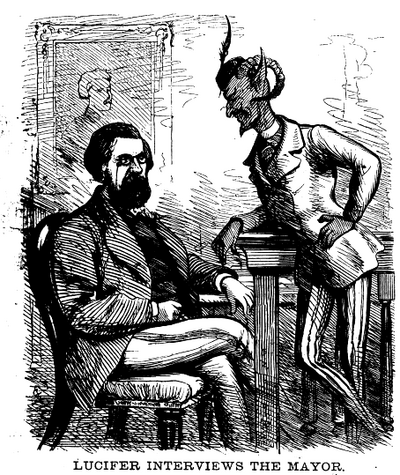 Photo: Mayor A. Oakey Hall, via upload.wikimedia.org
But federal officials had a problem: they'd already published preliminary figures. Admitting error would undermine confidence in the entire census system. Yet the numbers were so obviously absurd that ignoring the complaints wasn't an option either.
The Hunt for Missing New Yorkers
What followed was a bureaucratic detective story. Federal investigators descended on New York, armed with ledgers, maps, and a mandate to figure out how 300,000 people had vanished from the official count.
The answer, when it emerged, was almost embarrassingly simple.
A single clerk in the Census Bureau's New York office had made a transcription error. When transferring tallies from district sheets to the master ledger, he'd misread his own handwriting. What should have been recorded as population additions became subtractions. Entire neighborhoods disappeared with the stroke of a pen.
But the error had cascaded through the system. Other clerks, working from the incorrect master tally, had built their calculations on the flawed foundation. By the time the numbers reached Washington, the mistake had been compounded and certified as official.
America's First Urban Recount
Fixing the problem required something unprecedented: a complete recount of America's largest city. Federal marshals returned to the streets of Manhattan, Brooklyn, and the surrounding areas, going door-to-door to verify the actual population.
The recount took months. Residents grew tired of answering the same questions twice. Local newspapers mocked the federal government's inability to count accurately the first time. Political opponents used the chaos to attack the competency of the Grant administration.
Meanwhile, New York City's government operated in a strange limbo. How do you budget for a city when you're not sure if you have 500,000 residents or 800,000? How do you plan services when your official population might be off by 60 percent?
The Numbers Game
When the final, corrected count emerged, New York City's population was officially recorded at just over 940,000—nearly double the erroneous preliminary figure. The city hadn't lost residents; it had gained them substantially.
But the damage to federal credibility lingered. If the government couldn't accurately count people in its largest city, how could Americans trust any federal statistics? The incident sparked calls for census reform and better oversight of the counting process.
Legacy of a Ledger Error
The 1870 New York census crisis became a cautionary tale about the power of bureaucratic mistakes. A single clerk's error had nearly rewritten the political map, altered federal funding, and created a constitutional crisis over representation.
The incident also highlighted the growing complexity of American urban life. Cities were becoming too large and complicated for the informal counting methods that had worked in smaller, rural communities. The federal government needed new systems to track an increasingly urban nation.
When Arithmetic Attacks Democracy
Today, with computer systems and multiple verification processes, it's hard to imagine how a single person's math error could threaten to erase a major city. But in 1870, when ledgers were handwritten and calculations were done with pen and paper, human error could cascade into institutional crisis.
The New York census blunder remains a reminder that behind every official statistic lies a human being with a pen, and sometimes that human being has very bad handwriting. In a democracy that runs on numbers—votes, populations, budgets—even the smallest clerical mistake can have enormous consequences.
The 300,000 New Yorkers who temporarily disappeared from federal records were real people living real lives. They just happened to fall victim to the most consequential arithmetic error in American urban history.