The Day Australia's Army Surrendered to a Flock of Birds
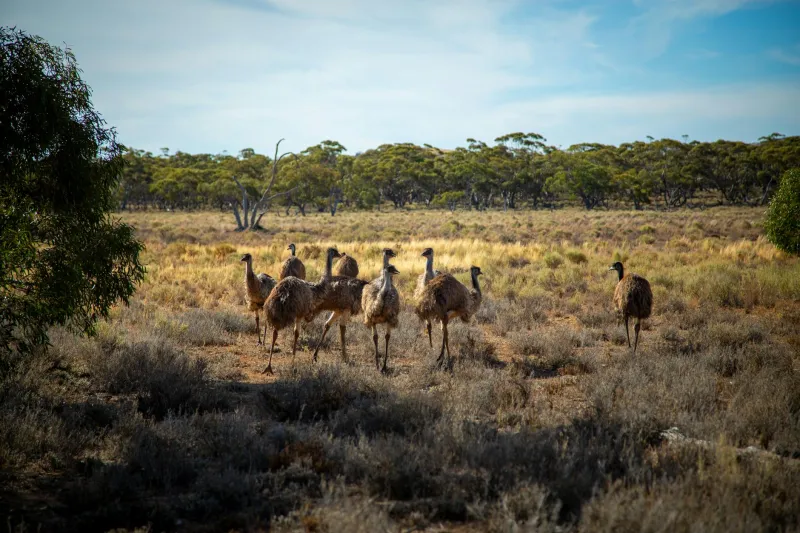
When Feathers Defeated Firearms
Picture this: a modern army, equipped with Lewis machine guns and military vehicles, declares war on a bunch of large birds. Three weeks later, the army retreats in defeat, having been thoroughly outmaneuvered by creatures whose battle strategy consisted entirely of "run really fast in different directions."
This isn't a cartoon or a fever dream—it's the Great Emu War of 1932, when Australia's military learned the hard way that emus are apparently better at guerrilla warfare than humans.
The Enemy Advances
After World War I, Australia settled thousands of veterans on farmland in Western Australia, promising them a peaceful life growing wheat. What they got instead was an invasion. Not from a foreign army, but from approximately 20,000 emus migrating from their inland breeding grounds toward the coast.
These weren't your average backyard birds. Emus stand six feet tall, weigh up to 130 pounds, and can sprint at 30 mph. When they descended on the wheat fields in late 1932, they didn't just eat the crops—they trampled them, destroyed fences, and turned months of agricultural work into a wasteland.
The farmers were desperate. They'd already survived a global economic depression and drought. Now giant birds were literally eating their livelihoods. They petitioned the government for help, and incredibly, the government responded by declaring war.
Military Intelligence Meets Bird Brain
Major G.P.W. Meredith of the Royal Australian Artillery was tasked with leading the operation. His mission: eliminate the emu threat using military precision and firepower. He arrived with two soldiers, two Lewis machine guns, and 10,000 rounds of ammunition.
The plan was simple: locate large flocks of emus, set up the machine guns, and mow them down with devastating efficiency. Military strategists estimated they could kill multiple birds with each burst of gunfire. After all, how hard could it be to hit a six-foot-tall target?
Very hard, as it turned out.
The First Engagement
On November 2, 1932, Meredith's forces encountered their first enemy formation: about 50 emus near Campion. The soldiers set up their machine guns and prepared for a massacre.
The emus had other plans. The moment the gunfire started, they scattered in every direction at maximum speed. The machine gunners managed to kill only a handful of birds before the entire flock vanished into the bush. The emus had instinctively executed a perfect dispersal maneuver that would have impressed actual military tacticians.
Tactical Superiority
Over the following days, the pattern repeated with embarrassing consistency. The emus demonstrated an uncanny ability to avoid concentrated firepower. They seemed to understand that staying bunched together meant certain death, so they developed a strategy: one emu would act as a lookout while the others fed, and at the first sign of humans, the entire group would scatter.
Even more humiliating, the emus learned to stay just outside the effective range of the machine guns. They would graze peacefully until the soldiers approached, then retreat to a safe distance and resume eating. It was as if they were taunting their human adversaries.
Major Meredith later reported that the emus "displayed a phenomenon that any military commander would envy"—the ability to communicate and coordinate without any apparent command structure.
The Retreat
After six days of combat, Meredith's forces had fired 2,500 rounds and killed an estimated 50 emus. The birds, meanwhile, continued destroying crops across hundreds of square miles. The military operation was suspended on November 8th, with officials citing the "mobility and cunning" of the enemy.
But the government wasn't ready to admit defeat. Two weeks later, they launched a second offensive with modified tactics. This time, they tried mounting machine guns on trucks to match the emus' mobility.
The emus adapted faster than the military. They began using terrain to their advantage, disappearing into dense scrubland where vehicles couldn't follow. When the trucks did catch up to flocks, the birds would split into smaller groups, making concentrated fire impossible.
Final Casualty Report
By early December, the military had expended nearly 10,000 rounds of ammunition and killed approximately 200 emus. Given that each machine gun burst cost more than the agricultural damage a single emu could cause, the operation was an economic disaster.
Meanwhile, the emu population showed no signs of decline. If anything, the survivors seemed to have learned from the experience, becoming even more elusive and organized.
On December 10th, the military officially withdrew, marking the end of Australia's brief and unsuccessful war against its own wildlife.
Lessons in Humility
The Great Emu War became an international embarrassment, with newspapers around the world mocking Australia's defeat. But it also revealed something profound about the relationship between technology and nature. Despite overwhelming firepower and military expertise, humans had been outsmarted by birds with brains the size of walnuts.
The emus succeeded because they had something the military lacked: perfect adaptation to their environment and an instinctive understanding of guerrilla tactics. They didn't need strategy meetings or intelligence reports—they just needed to be birds.
The American Connection
Americans might laugh at Australia's bird problems, but the U.S. has its own history of embarrassing wildlife defeats. The government has waged unsuccessful wars against everything from starlings to feral pigs, often with similar results. In 2019, the USDA spent $120 million trying to control invasive species, with mixed success at best.
The difference is that Australia was honest enough to call their operation a "war"—and honest enough to admit they lost.
Victory Belongs to the Swift
Today, emus remain abundant across Australia, while the Great Emu War is remembered as one of military history's most unusual defeats. The birds never signed a peace treaty, never agreed to terms of surrender, and never acknowledged human authority over their migration routes.
They simply continued being emus, which turned out to be the perfect military strategy all along.